
Programs for Faith
Communities
Good Dads Is Good for
Faith Communities
Although Good Dads is not faith-based, it is faith-friendly. By that we mean that Good Dads programs are very adaptable to the faith community. Fundamentals for Good Dads is ideal for ministry for men in any church or congregational setting. Good Dads Strong Schools can be easily adapted to programs that bring dads and their children together. New Pathways for Good Dads, which features Good Dads 2.0, is ideal for any faith community desiring to reach at-risk fathers. Finally, Good Dads Great Communities is designed to mobilize any group, including faith groups, to focus on fathers in a positive, engaging way.
Bring Fundamentals for Good Dads to Your Congregation
Given that more women than men are active participants in most religious congregations and faith communities, it may seem unusual to focus on fathers. However, research in psychology, sociology and religious studies alike suggests several reasons why a focus on fathers is important for any congregation.
Modeling and Influence
Fathers who actively practice their faith are more likely to influence their children’s religious behaviors and beliefs. This includes engaging in religious practices such as attending services, praying together or discussing religious teachings. Some studies suggest that a father is more influential on his child’s faith development than his mother.
Emotional Bonding
Children who feel a close connection to their fathers are more likely to adopt their fathers’ religious views and practices. This is especially true for children who perceive their fathers as consistent and authentic in their faith expressions.
Long-Term Impact
Any congregation desiring to ensure the health and longevity of their tradition will want to help fathers be as effective as engaged as possible with their children. The religious impact of fathers is often generational, extending beyond children to grandchildren.
Bundles & Purchasing Options
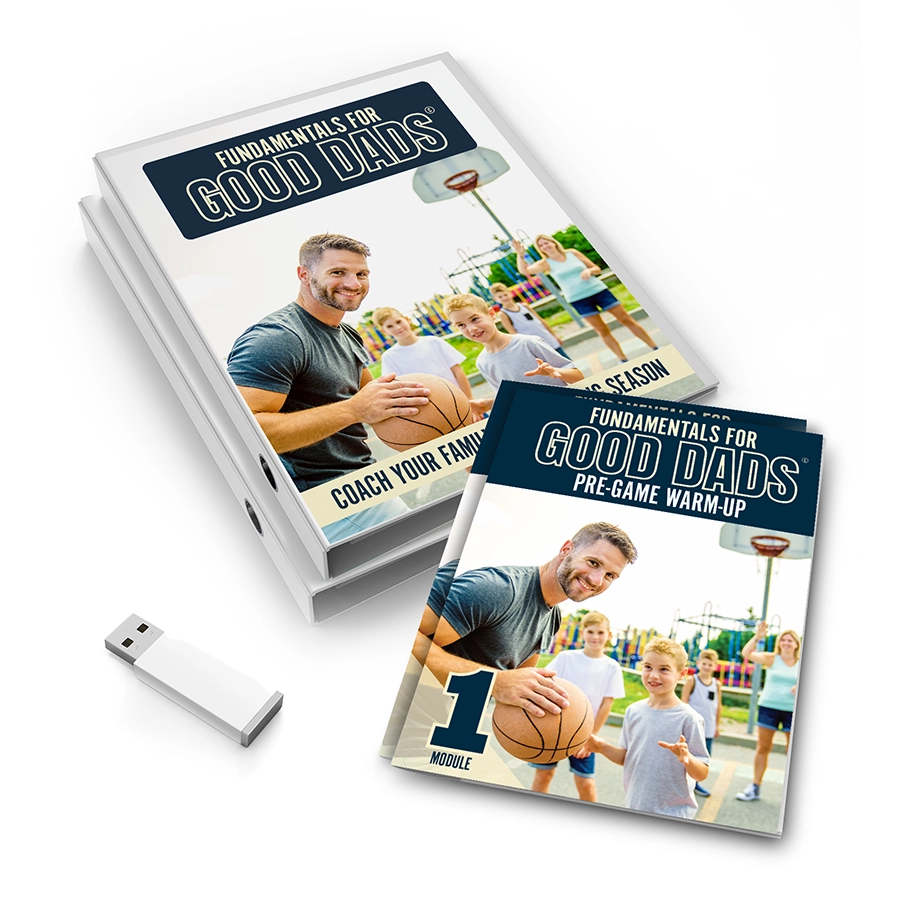
Head Coach Bundle
$349.95
- 2 Fundamentals for Good Dads Facilitator Books
- 1 flash drive containing all 8 Coaching Clips
- 20 sets of all 8 Fundamentals for Good Dads Participant Guides

Personal Trainer Bundle
$225.95
- 1 Fundamentals for Good Dads Facilitator Manual Binder
- 1 flash drive containing all 8 Coaching Clips
- 10 sets of all 8 Fundamentals for Good Dads Participant Guides
Looking for
other ways
to bundle?
To order additional Participant Guides, flash drives or any other Fundamentals for Good Dads materials, please contact us:
(417) 501-8867
info@gooddads.com
About the Course
Fundamentals for Good Dads is an 8-part course designed to encourage positive father involvement. The essential Good Dads playbook is the perfect way for any dad (including step-dads, grandfathers and father-figures) to become more engaged with their children.
The course paves the way to forging connections among fathers using familiar language and relatable examples common to any sports lover. It uses an extended coaching metaphor to illustrate that the winning habits successful coaches employ are many of the same strategies that good dads use to raise and lead healthy, happy families.
Workshop participants will explore the following:
- As a dad and as the coach of my family, what can I do to ensure we make it through hard times?
- How can I positively impact my family using my strengths?
- On whom can I rely?
Participants experience a fusion of engaging facilitator-led discussion topics and educational, impactful activities. They use multimedia expert testimonials from professional coaches chiefly relevant to twenty-first century fathers to cover big-picture topics like healthy masculinity, discipline and handling one’s emotions.
Course Objectives
Module 1 Pre-Game Warm-Up
- Understand the goals, format and content of the course.
- Establish rapport with facilitators and other participants.
- Work together to determine and explain acceptable group behavior.
- Explore, identify and discuss the similarities between coaching a team and leading a family.
Module 2 Goals for the Season—Values
- Recognize that a family, like any winning team, needs a game plan with goals to ensure success.
- Explain why rules and standards matter to a team and to families.
- Define “value” and describe the relationship between values and standards.
- Identify personal values and explain why they are important to a safe, stable and happy home.
- Describe the importance of shared couple values and standards to good parenting.
- Understand the influence of family of origin values to one’s adult values.
- Explain how and why values change as one matures.
- Relate how the values of a parent might influence a child’s wellbeing.
Module 3 Becoming a Valued Team Player
- Describe and summarize the impact of childhood role models.
- Evaluate the influence of various parenting role models from childhood on one’s current beliefs about what it means to be a good father or mother.
- Assess the impact of one’s beliefs on current parenting behavior.
- Reflect on the impact of a father’s absence on a child and articulate its effect on the ability to be a good parent.
Module 4 High-Potential Coaches
- Identify strengths of each family member.
- Describe the potential and contributions of each family member.
- Consider and reflect on one’s own strengths and weaknesses regarding parenting.
- Reflect on the ability to control your own attitude and temperament.
- Recognize and explain how each family has its own struggles and strengths.
Module 5 How You Impact Your Players
- Identify and describe the four primary parenting styles.
- Explain how parenting styles are related to a child’s self-management and self-confidence.
- Analyze various parenting scenarios and likely outcomes using various styles of parenting.
- Consider the ways parents may work together to develop the abilities of other family members using their own unique personalities and abilities.
Module 6 Developing Self-Confidence and Resilience
- Define and describe the importance of self-confidence.
- Identify parenting strategies that help encourage the development of confidence in one’s child along with when and why to use them.
- Examine and explain the relationship between accountability and responsibility.
- Identify age-appropriate tasks/chores for children.
- Identify reasonable and age-appropriate consequences for children.
Module 7 Managing Resistance and Conflict
- Explain why conflict is a natural part of life.
- Summarize the value of childish resistance.
- Detail how conflict with one’s children can be managed in positive ways.
- Identify and explain personal anger styles.
- Recognize cues when one is becoming angry.
- Explain and demonstrate ways of resolving conflict.
Module 8 Managing Stress in Your Coaching Network
- Identify and illustrate potential sources of stress in adults and children.
- Brainstorm coping strategies for stress (adults and children).
- Explain the importance of a support network.
- Identify people for one’s support network.
- Identify and demonstrate appropriate ways to ask for help.
- Recognize and construct an appropriate apology.
Discover More
"*" indicates required fields